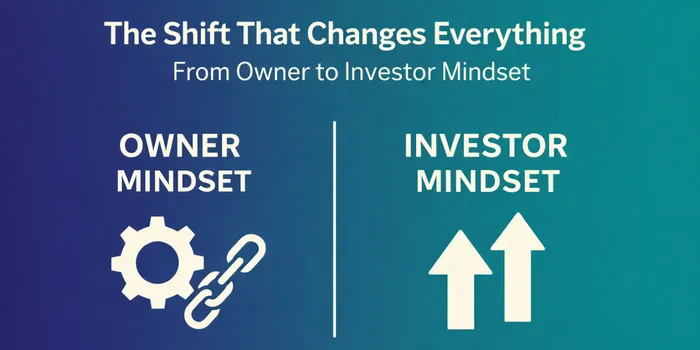
The Shift That Changes Everything: From Owner to Investor Mindset
Most business owners are stuck in the Owner Mindset. They’ve bought themselves a job, not built themselves a business. They work harder and harder, chained to the very machine they thought would give them freedom.
And then there are the few who break out. They make the shift from Owner to Investor. They stop working for their business and start making their business work for them. That’s the difference between being exhausted and being wealthy. Between being stuck in small-business prison and actually building freedom.
Let’s break down the key differences, the mindset shifts, and the exact framework you can use to transform from being an overworked owner to becoming a true investor.
Owner vs Investor: The Brutal Truth
Here’s the no-sugar-coating version.
Owner Mindset vs Investor Mindset
Time Focus
Decision Lens
Role in Sales
Money View
Risk Approach
Team Dynamic
Freedom
Exit Potential
If you recognise yourself on the “Owner” side of the list, don’t panic. The point isn’t shame. The point is awareness. The faster you spot it, the faster you can change it.
The Key Mindset Shifts
So what exactly has to change? Here are the seven core shifts that take you from Owner to Investor:
1. From Doing to Building
Owners say, “If I don’t do it, it won’t get done.” Investors say, “If I build the system, it will get done without me.”
That’s the whole game. Stop doing. Start building.
2. From Income to Asset
Owners see the business as their paycheck. Investors see the business as an appreciating asset.
That shift alone changes how you view every decision.
3. From Short-Term Survival to Long-Term Value
Owners panic about this week’s sales. Investors think about scalability, recurring revenue, and enterprise value.
4. From Control to Leverage
Owners grip tightly to everything. Investors leverage people, capital, and systems.
5. From Working Harder to Working Smarter
Owners believe hustle fixes everything. Investors believe leverage and strategy create exponential growth.
6. From Emotional to Strategic
Owners make fear-based decisions. Investors use data, ROI, and strategy.
7. From Identity to Independence
Owners cling to the identity of being “the boss.” Investors value freedom, impact, and building something bigger than themselves.
This isn’t theory. This is reality. If you stay in the Owner Mindset, your business will always be capped by your time, your energy, and your personal limits. If you shift into Investor Mindset, your business becomes unlimited.
Why Most People Stay Stuck
Here’s the problem: owners like being needed. They love being the hero, the one everyone calls, the fixer. It strokes the ego.
But that’s exactly what keeps them trapped.
The Investor Mindset requires letting go of ego and building something that can survive — and thrive — without you. That’s the hardest part for most. They’d rather complain about being busy than admit they don’t trust their team.
If you want freedom, you have to let go.
The Owner → Investor Coaching Framework
Here’s the exact step-by-step framework I use with clients to shift them out of the Owner trap and into the Investor seat.
Step 1: Identity Shift
Exercise: Ask: “If you were away for three months, what would break?”
Show them how much is dependent on them.
Reframe: their job isn’t to be the hero, it’s to be the architect.
Coaching Habit: Celebrate system wins, not personal wins.
Step 2: Financial Lens Upgrade
Exercise: Review financials. Teach them to think in enterprise value, not just revenue or wages.
Show them what a buyer looks for: profitability, scalability, predictability.
Coaching Habit: Every decision must answer: “Does this increase enterprise value?”
Step 3: Exit Thinking
Exercise: Pretend they’re selling in 12 months. What would a buyer demand? (Systems, contracts, customer stickiness, leadership depth, recurring revenue.)
Even if they don’t plan to sell, this discipline builds a more profitable, resilient business.
Coaching Habit: Run quarterly “sell-ready” reviews.
Step 4: Systems & People
Exercise: List everything they personally do. Circle what only they can do. Delegate or systemise the rest.
Build a “replace yourself” plan for each role.
Coaching Habit: Teach them to ask: “Who or what system can do this better than me?”
Step 5: Time Compression
Exercise: Audit where their time is wasted.
Introduce time-blocking (ABC123), the Ultimate Life Planner, or outsourcing.
Show them the ROI of buying speed — whether that’s tools, mentors, or acquisitions.
Coaching Habit: Weekly question: “What’s your highest value use of time this week?”
Step 6: Install Investor Rhythms
Weekly: KPI reviews and scoreboard updates.
Monthly: Strategy meetings, not problem-solving sessions.
Quarterly: Exit readiness reviews.
Coaching Habit: Replace owner-style “catch ups” with investor-level rhythms.
Step 7: Build Wealth Beyond the Business
Exercise: Create a personal wealth plan. Use business profits to invest in property, shares, or other assets.
Teach them to pay themselves like an investor, not like an employee.
Coaching Habit: Pull profits out and build wealth outside the business.
Quick Investor Checklist
Here’s the snapshot you can run through with any client:
✅ Identity shifted from worker → architect ✅ Thinking in enterprise value, not wages ✅ Systems replacing the owner week by week ✅ Investor rhythms installed Exit picture clear ✅ Wealth being built outside the business
If you can tick those off, they’re on the path. If not, they’re still stuck in owner land.
Case Example: The Two Builders
Let me give you a real-world example.
Two builders start similar businesses.
Builder A (Owner Mindset): He runs around quoting jobs, swinging a hammer, managing staff, and chasing payments. Every dollar depends on him. He’s exhausted. His business is worth nothing without him.
Builder B (Investor Mindset): He builds systems for quoting, trains a sales manager, creates repeatable marketing, and empowers a foreman to run jobs. He spends his time on strategy and culture. Within 5 years, his business can run without him — and is worth millions on the market.
Same industry. Same starting point. Different mindsets. Different results.
Why This Matters Now More Than Ever
We’re heading into an economy where weak businesses will be chewed up. Interest rates, competition, shifting markets — none of that cares how hard you work.
The ones who survive and thrive will be those who step out of the Owner role and operate as Investors. Those who build scalable, saleable, systemised machines.
The old model of “just work harder” is dead. If you want freedom, wealth, and impact, you need to make the mindset shift now.
Final Word
Here’s the truth bomb: Your business is either buying you freedom or it’s buying you another job.
If you stay in the Owner Mindset, you’ll always be trapped. You’ll always be busy. You’ll always be limited by yourself.
If you shift to Investor Mindset, you build a machine that works for you. You create wealth. You create freedom. You buy back your life.
The choice is yours.
Call to Action
If you’re serious about making this shift, don’t do it alone. Inside the Business Gym, we coach business owners every day through this exact transformation.
We give you the tools, the systems, the habits, and the accountability to shift from being just an Owner to becoming a true Investor.
If you’re ready to build an investment-grade business — one that runs without you and creates real freedom — then join us today.
If you are ready to compress time, join here now: https://www.skool.com/thebusinessgym/about?ref=c7aa31422f204551a9df58bc93ec0c89
Tagged Business Growth Strategy, Business Tips, Decision Making, Growth, Leadership Habits


